Java Property Market: Why Investors Are Overlooking It
02 Sept 2026
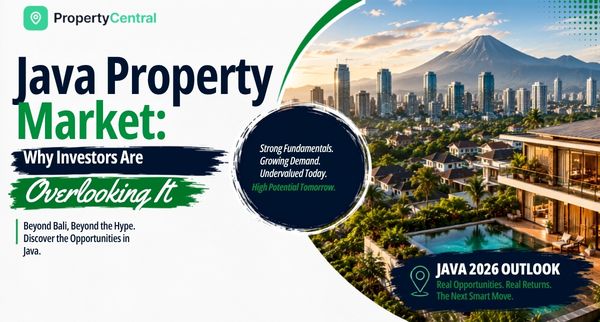
Java isn't ignored by capital it's Indonesia's financial and industrial core, and Jakarta alone is one of the largest metro economies in Southeast Asia. What Java actually lacks is attention from the foreign-buyer content ecosystem, which has spent the last five years almost entirely fixated on Bali. That gap matters, because it means less competition for information, lower relative entry prices in cities like Yogyakarta and Central Java, and property types apartments, urban leasehold, PT PMA commercial units that Bali's villa-heavy market doesn't offer.
However, when it comes to purchasing property in Indonesia, most advice focuses on Bali, and now Lombok. Yet, little is written about purchasing real estate in Java, a place where one can find Jakarta, Bandung, Yogyakarta, and Surabaya. This guide breaks down what property investment in Java Indonesia actually looks like city by city, what foreigners are legally allowed to buy, and where the real trade-offs sit and you can browse current Java property listings on Property Central as you read.
What Makes Java Different From Bali for Property Investors?
The Bali market revolves around tourists leasing villas for short periods, hence making yield and occupancy the focal point of every single article about Bali. Meanwhile, Java functions on an entirely different basis, relying on government administrative services, manufacturing, finance, and millions of residents. That means demand in Java comes from long-term renters, local professionals, and businesses not holidaymakers. It also means price appreciation tends to track infrastructure and economic growth rather than tourism seasons.
This distinction matters for anyone comparing yield numbers across islands, a topic covered in Property Central's Bali rental yield breakdown by area. Bali yields are driven by nightly rate and occupancy; Java yields are driven by monthly or annual leases to residents and companies. Neither is better by default they're different assets with different risk profiles.
In short: Java is a residential and commercial market first, a lifestyle market second. That's the opposite of Bali, and it's why the two shouldn't be evaluated with the same checklist.
Is Jakarta Real Estate Worth It for Foreigners?
Jakarta is Indonesia's economic capital, and its property market reflects that higher entry prices, but also the deepest liquidity and strongest infrastructure pipeline in the country, including ongoing MRT and toll road expansion. For foreigners specifically, ownership still runs through Hak Pakai (right-to-use) or a PT PMA structure, since freehold (Hak Milik) remains reserved for Indonesian citizens.
Jakarta Submarket | Profile | Typical Buyer Fit |
Central Jakarta | Highest prices, prime CBD | Long-term capital appreciation, commercial use |
South Jakarta | Expat-heavy, established residential | Rental income from professionals |
North & West Jakarta | Lower entry cost, industrial-adjacent | Value buyers, longer investment horizon |
Minimum purchase price thresholds apply to foreign buyers in Jakarta and are higher than in most other Indonesian cities, reflecting its status as the top-tier market.
In short: Jakarta real estate for foreigners isn't a bargain play it's a stability and liquidity play, best suited to investors prioritizing a functioning legal and financial system over headline yield.
How Do Bandung, Yogyakarta, and Surabaya Compare for Buyers?
These three cities are where the "overlooked" argument actually holds up. Each has a different draw:
City | Known For | Investment Angle |
Bandung | Startups, universities, cooler climate | Growing urban rental demand, West Java capital |
Yogyakarta | Culture, heritage, tourism (without Bali's price inflation) | Tourism-linked but far cheaper entry than Bali |
Surabaya | Indonesia's second-largest city, industry and trade | Practical, service-heavy market with lower price pressure than Jakarta |
Surabaya in particular suits buyers who want scale and services without Bali's resort volatility or Jakarta's price ceiling it's a fit for long-term residence or business access rather than a lifestyle purchase. Yogyakarta plays a different role: it has genuine tourism demand, similar in spirit to Bali a decade ago, but without the saturation or price run-up. Bandung sits between the two, driven more by its resident population, universities, and a growing tech and startup scene than by tourism.
In short: if the goal is buying property in Bandung, Yogyakarta, or Surabaya rather than Jakarta or Bali, the trade is lower price and lower name recognition in exchange for less competition and, in Yogyakarta's case, earlier-stage tourism growth.
What Are the Property Price Thresholds for Foreigners in Central Java?
Indonesia sets minimum purchase price requirements for foreign buyers, and these vary significantly by region this is one of the most consistently under-explained parts of Java's market. Central Java's thresholds sit well below Bali's and Jakarta's, which is the practical reason it comes up in the "overlooked" conversation: the legal minimum to qualify as a foreign buyer is simply lower.
That lower threshold cuts both ways. It opens the market to buyers who'd be priced out of Bali or Jakarta, but it also usually reflects thinner resale demand and a smaller pool of comparable transactions to benchmark value against. A lower entry price isn't the same as a better deal it needs to be weighed against how easily the property could be resold or re-leased later.
In short: Central Java property prices for foreigners are genuinely more accessible, but accessibility isn't the same as liquidity, and that gap is the real risk to underwrite.
How Can Foreigners Legally Buy Property in Java?
The legal path is the same across Java as it is in Bali Indonesia's ownership rules are national, not regional but it's worth restating clearly since so much bad information circulates around "workarounds."
Confirm the ownership route. Foreigners cannot hold Hak Milik (freehold). The two legal paths are Hak Pakai (right-to-use, typically renewable, suited to residential purchases) and a PT PMA (foreign-owned company structure), which suits commercial or investment-driven purchases.
Check the minimum price threshold for the specific city. Thresholds differ by region and are set by government regulation, so a property that qualifies in Central Java may not meet the minimum in Jakarta.
Engage a licensed PPAT (Land Deed Official). Every legitimate land transaction in Indonesia must go through this notary, who handles the legal paperwork and confirms the sale complies with local law.
Avoid nominee arrangements entirely. Using an Indonesian citizen as a nominee to hold freehold title on a foreigner's behalf is illegal and offers no real legal protection if the arrangement is challenged a point Property Central's guide on foreign ownership rules in Bali covers in more detail, and the same warning applies across Java.
Budget for taxes, notary fees, and ongoing costs, not just the purchase price, before committing.
In short: the legal mechanics don't change between islands what changes is price, liquidity, and how competitive the local market is around each mechanism.
What Are the Risks of Investing in Java's Property Market?
The main risk isn't legal it's informational. Bali and Lombok now have years of accumulated pricing data, agent networks, and buyer reviews that make it easier to sanity-check a deal. Java's secondary cities have far less of that infrastructure built around foreign buyers specifically, which means more due diligence falls on the buyer and their notary rather than on comparable market data.
A second risk is liquidity. Lower entry prices in places like Central Java or Yogyakarta can mean a smaller pool of future buyers, particularly foreign ones, if the goal is eventual resale rather than long-term hold or rental income.
In short: the risk in Java isn't the legal structure it's the thinner information and resale market compared to Bali, and that should shape how conservatively a buyer prices their exit.
Is Now the Right Time to Invest in Java?
Java isn't undervalued in the way "hidden gem" content usually implies Jakarta is a fully priced, mature market. The opportunity is narrower and more specific: Bandung, Yogyakarta, and parts of Central Java offer lower entry costs and less foreign-buyer competition than Bali right now, for investors willing to accept a thinner resale market in exchange for that lower price. This suits a long-term hold or income strategy far better than a quick flip.
Frequently Asked Questions
Is Java a good place for foreigners to invest in property?
Yes, with the caveat that "Java" isn't one market. Jakarta suits investors prioritizing liquidity and infrastructure; Bandung, Yogyakarta, and Surabaya suit buyers prioritizing lower entry cost over brand recognition or resale speed.
Can foreigners buy property outright in Java?
No. Foreigners cannot hold Hak Milik (freehold) anywhere in Indonesia, Java included. The legal routes are Hak Pakai (right-to-use) for residential property or a PT PMA structure for commercial and business-linked purchases.
Is Jakarta more expensive than Bali for property investment? Generally yes at the prime end Central Jakarta carries some of the highest minimum price thresholds in the country. Outer Jakarta districts and Central Java cities can undercut Bali's tourist-zone prices considerably.
What's the biggest mistake foreign buyers make in Java?
Treating it like Bali expecting short-term rental yield data and tourism-driven demand, when most of Java's market runs on long-term residential and commercial leasing instead.
Should I choose Java or Bali for my first Indonesian property investment?
It depends on the goal. Bali suits short-term rental income and lifestyle-linked buyers; Java suits investors focused on long-term hold, lower entry cost, or business presence in Indonesia's economic core.