Bali Property Investment ROI: Rental Yield by Area
11 Aug 2026
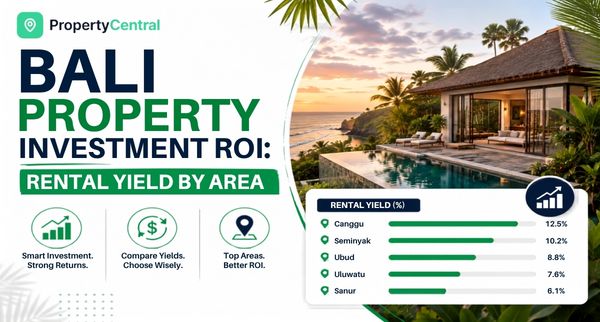
Bali rental yields vary sharply by area. Canggu delivers the highest gross yield (roughly 12–18%), Uluwatu follows close behind (10–16%) with the fastest land appreciation, Ubud sits at 10–15% with lower entry prices, and Seminyak offers the most stability at 10–14% but the least upside. Following deductions for management costs, taxation, and vacancy, the net yield will be 4-6% with self-management and 8-13% with professional management. There is no single “ideal” location; the appropriate location will depend on your budget, appetite for risk, and whether you want cash flow or capital appreciation.
If you're comparing properties for sale across Bali, this breakdown will help you match a location to your actual investment goal rather than chasing the highest headline number.
Why “Bali rental yield” is a misleading search in the first place
Every villa listing site advertises “up to 20% ROI.” Almost none of them explain that this number is gross yield the rent collected before you pay anything. What you actually keep, the net yield, is a different figure entirely, and it can be less than half the headline number once you subtract:
Property management fees (typically 20–30% of gross rental income)
Local tax (PPh) on rental income
Maintenance, staff, and utilities
Vacancy periods, especially outside peak season
A villa marketed at “15% ROI” self-managed by an owner with no local presence often nets closer to 4–6%. A professionally managed villa in a strong location can hold onto 8–13% net. That gap between 4% and 13% isn't the location it's operations. This distinction matters more than which neighborhood you pick, and it's worth understanding before you compare areas at all.
Canggu: highest yield, highest competition
Canggu is still Bali's most mature rental market because of the combination of vacationers, digital nomads, and remote workers staying there for extended periods. Gross yields in Canggu range from 12% to 18%, with entry-level prices being approximately USD 300,000 for a suitable villa for investors.
For whom it's right: For investors who want to focus on occupancy and liquidity rather than capital gains. Canggu villas are the easiest to sell in Bali since there is no downtime in terms of demand.
The downside: Land prices have soared recently, and the market has matured enough that an inferior villa in an oversupplied submarket (central Berawa, for example) will outperform a good villa in an undersupplied location. Gross and net yields become lower the larger the villa – 2 bedroom performs better than 4 bedroom.
Browse current Canggu listings to compare asking prices against these yield ranges before assuming a number applies to a specific property.
Uluwatu: the fastest-growing, lowest-entry play
Uluwatu has quietly emerged as the highest yielding destination for one type of buyer. The land is still 30-40% cheaper per square meter compared to Canggu, whereas gross yields range from 10-16%, which sometimes are even slightly higher for the right positioned clifftop or beach access villas that cater to affluent travelers.
For whom it fits: Those buyers who are prepared to trade off the liquidity for cheaper entry point and better appreciation prospects. Uluwatu at the moment experiences the fastest growing land values among the four destinations discussed.
The downside: Less number of year-round visitors than Canggu. Uluwatu is more of a seasonal destination; therefore, the occupancy must be more realistic, which in Bali reaches 65-75%, and never 85-90% as it is often advertised.
Ubud: lower entry price, steadier long-term thesis
Ubud is not the yield leader, but it's not far off either 10–15% gross yield is achievable, and entry prices are the lowest of the major zones, often USD 200,000–600,000. Ubud draws a different guest profile: wellness travelers, long-stay remote workers, and repeat visitors rather than short-term party tourists.
Who it suits: Lower-capital investors, or anyone who wants a long-term land-value thesis with steadier, less volatile income rather than chasing peak-season spikes.
The catch: Occupancy is generally less dense than the coastal corridor, and rental rates per night are lower, which is why yield stays competitive despite cheaper property it's a volume trade-off, not a premium one.
Seminyak: the mature market, lowest risk, lowest upside
Seminyak is Bali's most established investment area, and that maturity cuts both ways. Yields here run 10–14%, the lowest of the four, because land prices especially around Petitenget, Oberoi, and Laksmana have already priced in most of the growth. This is not where you'll find a bargain in 2026.
Who it suits: Investors who want stability and the deepest liquidity over maximum return. If capital preservation matters more to you than squeezing out an extra few percent, Seminyak's track record is the most predictable of the four.
The catch: Limited upside. You're paying a premium for certainty, and that premium has already compressed future appreciation.
So which area is actually “best”?
There isn't one answer that's the honest conclusion, even if it's less satisfying than a ranked list:
Want the deepest, most liquid rental market? Canggu.
Want the strongest growth-to-entry-price ratio? Uluwatu.
Want the lowest capital requirement with a steady long-term thesis? Ubud.
Want maximum stability and easiest resale, and can accept lower yield? Seminyak.
What all four have in common: the gap between a good and a bad outcome in the same area is almost always driven by management quality, not location. Before comparing neighborhoods, confirm who will actually run the property day to day, and stress-test any yield projection at 60% occupancy, not 85%.
Before you commit capital
Ownership structure changes the math on every area above leasehold has capped upside compared to freehold-equivalent structures, and getting this wrong is a common, expensive mistake for first-time foreign buyers. If you haven't already, read our breakdown of how foreign ownership actually works in Bali before you shortlist a property. And if you're considering a pre-construction unit for a lower entry price, check our guide on vetting an off-plan developer first stalled projects are a real risk in this market, not a hypothetical one.
Frequently asked questions
Is Bali villa investment still worth it in 2026?
Yes, for buyers with realistic expectations. Net yields of 8–13% with professional management, plus mid-single-digit annual capital appreciation in strong areas, remain achievable. It's not the 20%+ risk-free story some listings imply.
What's the difference between Canggu and Ubud as an investment?
Canggu offers higher gross yield and deeper liquidity but higher entry prices and more competition. Ubud offers a lower entry price and steadier long-term demand but slightly lower nightly rates.
How much Airbnb income can a Bali villa realistically generate?
Assume 65–75% occupancy in a prime area, not 85–90%. Multiply that against realistic nightly rates for your specific villa size and area, then subtract 20–30% for management before you estimate net income.
Do I need a management company to hit these yield ranges?
Not strictly, but self-managed villas without a local presence typically net 4–6%, roughly half of what professionally managed properties in the same area achieve.
This article is intended as general market information, not financial or legal advice. Rental yield figures vary by specific property, management quality, and market conditions, and should be independently verified before you make a purchase decision. Ready to compare real listings? Explore properties across Bali and Indonesia on Property Central.