Lombok Property Market 2026: Is It Bali 10 Years Ago, or a Different Risk Profile Entirely?
26 Aug 2026
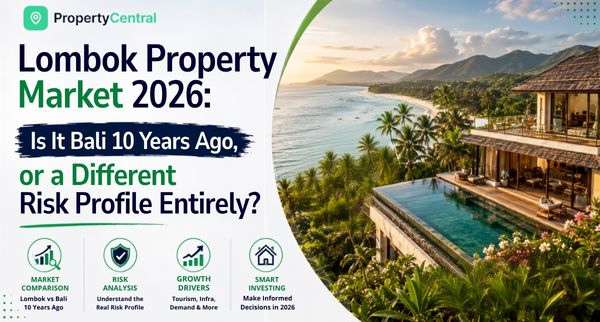
Lombok land costs 50–70% less than Bali and gross yields run higher, but the comparison to "early Bali" breaks down on infrastructure timing, legal risk, and liquidity. Lombok isn't a discount version of Bali's past. It's a different market with its own risks, and treating it as a rerun is how investors miss the real ones. At Property Central, we track both markets side by side, so this breakdown is built on what's actually moving, not just what's being pitched.
What Is Driving the Lombok Property Investment Boom?
Three things are converging on Lombok at once. First, the $3 billion Mandalika Special Economic Zone in South Lombok has brought international hotel brands, a MotoGP circuit, and direct international flights through Lombok International Airport. Second, land prices in emerging areas remain far below Bali's, with leasehold land starting around $30,000–50,000 and completed villas from roughly $150,000 you can see current Lombok properties for sale and rent to gauge where prices sit today. Third, tourism arrivals are outpacing accommodation supply, which is the exact condition that pushes rental yields up.
That combination is real. It's also precisely the setup that gets sold as "the next Bali," and that framing deserves scrutiny before you wire a deposit.
In short: government-backed infrastructure spending, cheap land, and a supply-demand gap are the genuine drivers. None of them guarantee the outcome Bali had.
Is Lombok Really "Bali 10 Years Ago"?
Partially, and the parts that don't match matter more than the parts that do. Bali's growth in the 2010s was driven by organic digital-nomad and tourism demand that built slowly, area by area, with infrastructure catching up afterward. Lombok's growth is being driven top-down by a single government-anchored project (Mandalika) plus scattered private development. That's a different growth mechanism, not a delayed copy of the same one.
A top-down, project-anchored market can move faster, but it's also more concentrated. If Mandalika's tourism numbers underperform, or a competing SEZ elsewhere pulls investment, the areas built around that anchor don't have Bali's decade of diversified demand to fall back on. Bali also had 15+ years to build out its legal, notarial, and property-management infrastructure. Lombok is building that infrastructure in real time, alongside the buying activity, which is why due diligence failures are more common there right now.
In short: Lombok shares Bali's early low-price, high-yield profile, but it lacks Bali's slow-built demand base and mature transaction infrastructure. That's a meaningfully different risk, not a time-delay of the same risk.
How Do Lombok and Bali Real Estate Actually Compare?
Factor | Lombok | Bali |
Land entry price | 50–70% lower | Higher, established |
Gross rental yield | ~13–22% (reported) | ~10–18%, varies sharply by area |
Legal/notarial infrastructure | Developing | Mature |
Buyer pool for resale | Thin, growing | Deep, established |
Growth driver | Government SEZ-led (Mandalika) | Organic tourism-led |
Foreign ownership route | PT PMA / HGB / Hak Sewa | Same legal framework |
The yield numbers look better on paper in Lombok, but yield and liquidity are different things. A high gross yield on a property you can't resell in a thin market isn't the win it appears to be on a spreadsheet.
In short: Lombok wins on entry price and headline yield. Bali wins on market depth and exit liquidity. Which one matters more depends on whether you're buying to hold for income or planning to sell within five years.
What Legal Structures Can Foreigners Actually Use in Lombok?
The legal framework is identical to Bali's, because it's national law, not island-specific. Foreigners cannot hold Hak Milik (freehold title) under Indonesia's 1960 Basic Agrarian Law that right is reserved for Indonesian citizens. Foreign investors instead use one of three routes: a PT PMA (foreign-owned company) holding Hak Guna Bangunan, or an individual long-term lease through Hak Sewa or Hak Pakai. As of 2025 regulatory updates, PT PMA minimum paid-up capital sits around IDR 2.5 billion (roughly USD 165,000), and setup costs for the structure run an additional $950–2,200 on top of that.
Nominee arrangements, where a local individual holds Hak Milik "on behalf of" a foreign buyer, are legally void in Indonesia. If a dispute arises, courts recognize the nominee as the actual owner, and the foreign investor has no enforceable claim. This isn't a gray area or a workaround with acceptable risk. It's a structure with zero legal standing, and property agents who suggest it should be treated as a red flag, not a shortcut.
In short: the legal path in Lombok is the same PT PMA / HGB / Hak Sewa framework used across Indonesia. There's no Lombok-specific shortcut, and any agent offering a nominee deal is offering you no legal protection at all.
What Are the Real Risks of Investing in Lombok Property?
The biggest one is title verification, not price. The usual types of fraud include the double sale of the same plot to different parties, boundary claims, and the use of forged documents. The rural land usually has ownership based on adat (customary), and thus the ownership can be recorded informally in the form of Girik or Certificate C rather than the more formal BPN certificate. According to GR 18/2021 and ATR/BPN Regulation 16/2021, this informal land title should convert into the formal one before 2026; otherwise, the land title will become invalid.
There’s another lesser-known hazard related to road access. Simply having a visible road accessing the property does not legally mean you have rights to that access unless it is formally documented within the deed or in an easement agreement. Factor in the nascent utility systems in developing areas of Lombok, and you may find that “cheap land” comes with unexpected costs to bring it into use.
In short: the risks aren't hypothetical, they're procedural. Title fraud, unregistered land, and undocumented access rights are the specific, checkable things that separate a legitimate deal from an expensive mistake.
Is Lombok Safe to Invest in Property Right Now?
Yes, conditionally. Lombok is broadly safe for property investment when you use a licensed PPAT notary, verify the certificate directly at the local BPN office, and structure ownership correctly through PT PMA or Hak Sewa. It is not safe if you skip independent title verification, rely on agent assurances instead of BPN records, or accept a nominee arrangement. The risk in Lombok isn't the island. It's the gap between how fast the market is moving and how fast its legal infrastructure has matured to support that pace.
In short: safety here is a function of process, not location. The same land can be a sound investment or a costly mistake depending entirely on whether due diligence was done properly.
Where Should You Buy in Lombok?
South Lombok, particularly Kuta, Selong Belanak, and Tanjung Aan, carries the strongest growth case due to direct proximity to Mandalika SEZ. Central Lombok suits buyers targeting eco-tourism demand. North Lombok, around Senggigi, is the most established area with more built-out infrastructure and a longer transaction history, which trades some upside for lower risk. None of these are risk-free, but they represent genuinely different risk-return positions rather than the same bet at different price points.
In short: location choice in Lombok is a trade-off between growth potential (South) and market maturity (North), not a single "best" answer.
So, Is Lombok a Better Bet Than Early Bali?
Lombok offers a genuinely different opportunity than Bali did a decade ago, not a discounted rerun of it. The pricing and yield advantage is real and worth taking seriously. But the growth driver is more concentrated, the legal infrastructure is younger, and the buyer pool for resale is thinner. Treat it as its own market with its own checklist, not as Bali on a ten-year delay, and the opportunity is worth evaluating on its own terms. If you want to see what's actually available, browse villas, land, and off-plan listings in Lombok directly.
Frequently Asked Questions
Is Lombok cheaper than Bali for property investment?
Yes. Land prices in Lombok run 50–70% below comparable areas in Bali, and completed villas typically start lower as well. The trade-off is a thinner resale market and less mature supporting infrastructure.
Can foreigners legally own property in Lombok?
Foreigners cannot hold freehold (Hak Milik) title. Legal ownership routes are a PT PMA company holding Hak Guna Bangunan, or an individual long-term lease through Hak Sewa or Hak Pakai. These are the same structures used across Indonesia, not Lombok-specific arrangements.
What is the Mandalika Special Economic Zone and why does it matter?
Mandalika is a $3 billion government-backed development in South Lombok anchoring international hotel brands, a MotoGP circuit, and expanded international flight access. It's the primary infrastructure driver behind current Lombok property demand, concentrated mainly in South Lombok.
What is the biggest risk when buying land in Lombok? Title verification. Double sales, disputed boundaries, and unregistered adat land (Girik or Letter C documents) are the most common sources of loss. Cross-checking the certificate directly at the local BPN office before paying anything is the single most important due diligence step.
Is Lombok's rental yield really higher than Bali's?
Reported gross yields in Lombok run higher (roughly 13–22% versus 10–18% in Bali), but gross yield doesn't account for Lombok's thinner buyer pool and less developed property management sector. Net returns depend heavily on how well the property is managed and how easily it can be resold if needed